East Asian Scent Materials for a Vegan Brand: Natural vs Nature-Identical
For a vegan-positioned brand, the A/B question on East Asian scent materials is not natural or synthetic — it is whether you need the botanical itself or a nature-identical material that behaves like it. Naturals carry the better story and the harder supply problems; nature-identical versions give consistency, clearer allergen data and an unambiguous vegan line. Most briefs are better served by deciding material by material, with the story spent only on the materials that earn it.
Key takeaways
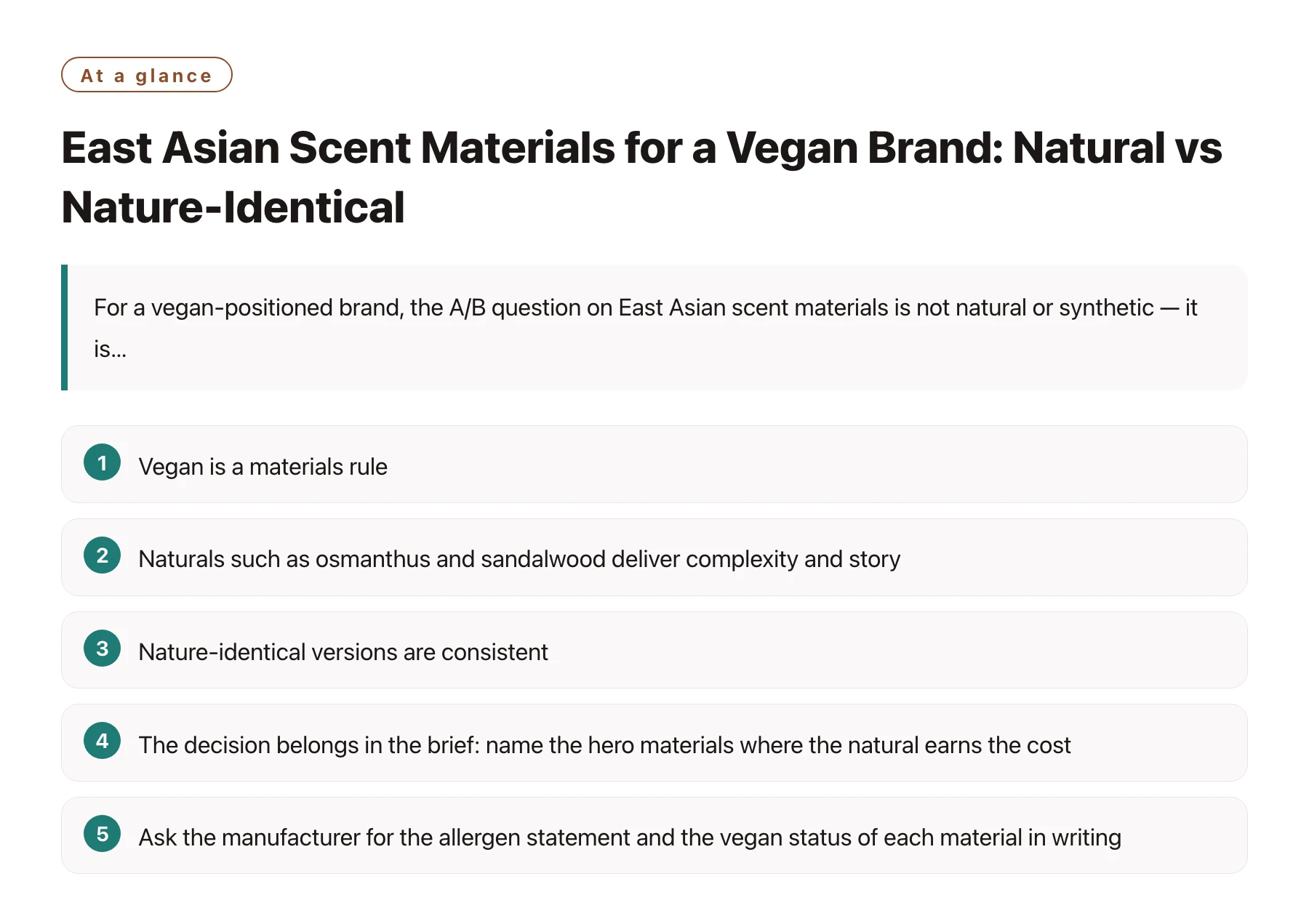
- Vegan is a materials rule, not an all-natural rule: animal-derived tinctures are out, but nature-identical molecules are fully compatible with a vegan claim.
- Naturals such as osmanthus and sandalwood deliver complexity and story, at the price of batch variance, allergen data and supply risk.
- Nature-identical versions are consistent, easier to document and usually cheaper at volume, which is why most everyday products use them.
- The decision belongs in the brief: name the hero materials where the natural earns the cost, and allow accords everywhere else.
- Ask the manufacturer for the allergen statement and the vegan status of each material in writing, not as a verbal reassurance.
A vegan-positioned fragrance brand building an East Asian scent identity runs into a specific trap: the region's most evocative materials — osmanthus, jasmine sambac, tea, sandalwood, oud — exist in nature, and natural feels like the obvious answer for a clean positioning.
The trap is that natural does not equal vegan, consistent or affordable. This article compares the two material routes — botanical extracts and nature-identical molecules — across the dimensions that actually decide a brief, then shows how to brief a manufacturer about materials.
The vegan constraint changes how you read a material list
Vegan restrictions are about animal origin, not about molecules: no civet, no ambergris, no animal musk, and no incidental animal-derived carriers such as shellac or milk derivatives. A nature-identical molecule is vegan by definition; a natural material needs its sourcing checked.
Reference databases such as The Good Scents Company document both the botanical sources and the synthetic versions of most classic materials, which makes the natural-versus-identical comparison concrete before you ever brief a factory [1].
The formulation reality is that most fine fragrance uses a blend anyway — a trace of natural complexity dressed by nature-identical material. The vegan question then becomes how the blend is documented, which is where the supplier's material statements matter.
The two routes, dimension by dimension
| Dimension | Natural botanical extract (A) | Nature-identical material (B) |
|---|---|---|
| Batch consistency | Varies with harvest, season and supplier | Stable, by specification |
| Allergen disclosure | Depends on the extract's full composition | Usually easier to document |
| Sourcing and supply | Weather-, region- and price-sensitive | Predictable and scalable |
| Vegan clarity | Needs per-material sourcing checks | Clean by definition |
| Longevity in the formula | Complex and prized when it works | Reliable, sometimes simpler |
| Story on the label | Real osmanthus — hard to match | Weaker story, better economics |
Read it as a portfolio decision: the naturals earn their cost where the story is the brand, and nature-identical material carries everything else.
The hero materials, one by one
If the region's materials are new to you, smelling them side by side is worth an afternoon before you commit a brief; scent museums with material displays make that comparison immediate, and browsing the displays in the immersive scent museum in Guangzhou is one practical way to do it the immersive scent museum.
Osmanthus
The natural extract is apricot-like, leathery and tea-like all at once, and it is neither cheap nor consistent. A nature-identical base gives the apricot sweetness with dependable stability, which is why most osmanthus-forward products use an accord built on it.
Tea — oolong, matcha, smoked
Tea accords are built from dry, slightly bitter notes; the naturals are subtle and expensive, so nature-identical teas carry most formulas. The storytelling can stay on the tea itself without paying the raw-material premium.
Sandalwood
The natural has a creamy warmth that is difficult to replace, but its price and supply volatility make it a hero-material decision. Nature-identical sandalwood molecules are good enough for blends and are the standard choice in most vegan lines.
Oud and deep woods
Oud naturals are rare, costly and tightly regulated in sourcing; virtually every commercial oud is built from nature-identical materials and synthetic accords. For a vegan brand that wants the depth without the sourcing story, an oud accord is the honest answer.
Briefing the manufacturer about materials
Bring priorities, not molecules: tell the supplier which materials are hero naturals and what budget they have, and which are allowed to be accords. The supplier's material library then answers with options — a strong brief produces a shortlist, a weak one produces questions.
Ask for three documents in the quotation: the allergen statement, the vegan status of each material including carriers and colourants, and the source of any natural. Suppliers invest in stable sourcing and in nature-identical alternatives precisely because brands now ask these questions, and the responses reveal the depth of the ingredient operation [2].
The fragrance industry's own education materials describe how ingredients are defined and combined, which is a useful neutral check when a supplier's story and the formula listing disagree [3].
Then choose the route by project. If you want the scent built to your material rules and you know exactly which materials you want, an OEM structure keeps control in the brand — you arrive with the rules, and an OEM partner for perfume brands executes them an OEM partner for perfume brands. If the positioning needs an experienced nose to translate the region's classics into an accords-first formula, a fragrance house with decades of compounding, such as Xuelei fragrance house, can usually show how similar briefs resolved before you invest in the category knowledge yourself.
Write vegan into the contract as a material rule, not as a word on the box. Define what is excluded — animal-derived substances, and any carrier or adjunct derived from animals — and make the supplier's statement part of the approval checklist for each batch.
Sources
- The Good Scents Company —— A reference database of aroma materials with odour descriptions, CAS numbers and typical usage information.
- Symrise —— A global fragrance and flavour manufacturer; public information on scent creation, raw materials and research.
- The Fragrance Foundation —— A non-profit organisation for the fragrance industry, running perfumery education programmes and industry recognition.
Frequently asked questions
Is natural automatically vegan?
No. Naturals can come from animals, and vegan claims can fail over carriers and processing aids. Vegan refers to the animal-origin rule; natural refers to the botanical source. The two overlap often but are decided by different checks.
Can a nature-identical material be called vegan on the label?
Vegan claims describe animal origin, not synthesis, so nature-identical molecules are vegan-compatible. The label wording depends on your market's rules about natural claims, so keep the vegan claim and the natural claim as two separate statements.
Which East Asian materials are hardest to source as naturals?
Osmanthus absolute, oud and genuine sandalwood are the usual suspects: limited supply, price volatility and, for oud, tightly regulated sourcing. Those are exactly the materials where a nature-identical accord usually carries the formula.
How do I check that a supplier's material is really vegan?
Ask for the vegan status per material, the source of each natural and the carrier list, in writing. For certified claims, ask which certification body issued the certificate and check it rather than the label wording.
Should a vegan brand avoid naturals entirely?
No. Naturals are a legitimate choice where the story and the budget allow, with the sourcing checks done. The practical rule is: hero naturals where they earn the narrative, nature-identical everywhere else.